12 questions to ask before hiring a marketing agency
Questions to ask before hiring a marketing agency, on who owns your ad accounts and domain, how ad spend is billed, how results are checked and how you leave.

LukaAdvertising11 min read
Key takeaways
5 things to take awayThe questions to ask before hiring a marketing agency cover ownership, money, proof and how you get out of the contract.
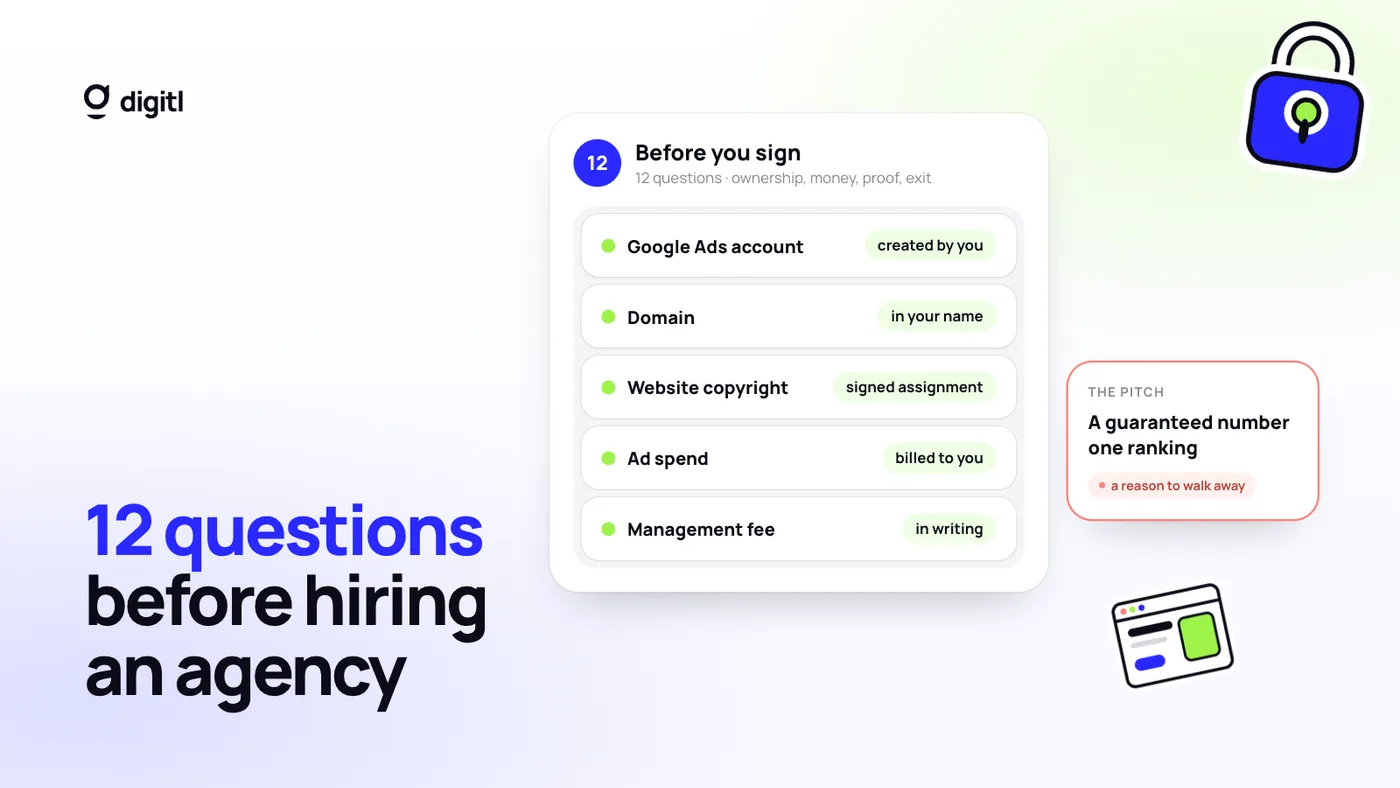
A Google Ads account that an agency creates from its manager account makes the agency its owner, so create the account yourself.
Google says no one can guarantee a number one ranking, so a guaranteed position is a reason to walk away.
In the US and the UK, paying for a website doesn't transfer its copyright to you. That takes a written, signed assignment.
Google requires agencies that charge a separate management fee to disclose it in writing and to report ad costs exactly as Google charged them.
If an agency creates your Google Ads account from its own manager account, Google makes the agency that account's owner automatically. So the first question to ask an agency has nothing to do with strategy.
Before you sign, ask who will own your accounts and website, and what you pay for. Then ask how results will be checked and how you can leave. The clearest red flags are guaranteed rankings, accounts in the agency's name and reports you can't check against your own data.
| # | Question | Red flag in the answer |
|---|---|---|
| 1 | Who will create the Google Ads account? | "We'll run it from our account" |
| 2 | Who will own Analytics, Tag Manager, Search Console and your Business Profile? | Everything under the agency's login |
| 3 | Whose name is the domain registered in? | The agency as the registrant |
| 4 | Who will own the website's design, code and copy? | No written assignment |
| 5 | What does the monthly fee cover? | A fee with no list of tasks |
| 6 | Will Google bill the ad spend to you? | One blended monthly figure |
| 7 | What will you measure, and how? | Reach as the goal |
| 8 | Can I check the report in my own accounts? | A PDF with no account access |
| 9 | Can you show past work I can check? | Case studies with no names |
| 10 | What is the minimum term and notice period? | An automatic renewal nobody mentioned |
| 11 | What will you hand back when we part ways? | "We'll sort that out at the time" |
| 12 | How will you take over from my last agency? | A fresh account |
A marketing agency is an outside firm that plans and runs a business's ads, search and website work for a monthly fee. The same twelve are the questions to ask before hiring a digital marketing agency for one channel, such as Google Ads.
Who will own your accounts, domain and website?
Four assets decide who owns your marketing: the ad account, the analytics data, the domain and the website, and each one belongs in your name.
1. Who will create the Google Ads account?
A manager account is a Google Ads account that lets an agency run many clients' accounts from one login. If the agency creates your account from it, Google Ads Help says the manager automatically becomes the owner. If you create the account and the agency links to it, the agency gets no ownership by default.
Only an admin can give access, change access levels or unlink a manager account. Keep admin access on your own business email.
Red flag: "We'll set it up in our account for you."
2. Who will own Analytics, Tag Manager, Search Console and your Business Profile?
Each of these Google tools has a top role, and that role should be yours. The Analytics Administrator can add and delete users, and a Search Console owner can add and remove them. On a Google Business Profile, only the owner can add users or delete the profile.
Tag Manager warns that if the sole administrator changes roles, you can get locked out. Keep two admins, one of them you.
Red flag: "It all sits under our agency login, and we'll send you the reports."
3. Whose name is the domain registered in?
The registrant is the person or business a domain is registered to, and ICANN says the registrant assumes sole responsibility for it. Under ICANN's Transfer Policy, the registrant is the only party that can approve a move to another registrar. A domain in the agency's name needs its say for every later move.
Red flag: "We register it in our name to save you the hassle."
4. Who will own the website's design, code and copy?
Paying for a website doesn't make you its copyright owner. In the US, copyright vests initially in the author, and a commissioned site is a work made for hire only if it meets all four criteria the US Copyright Office lists. Any other transfer must be in writing and signed.
UK law lands in the same place. The author is the first owner of the copyright, and an assignment is not effective unless it is in writing and signed for the agency.
One clause that passes the copyright to you on final payment fixes this, so have a lawyer or solicitor read it.
Before you talk to any agency, check your site for free with Google's own phone test, in about twenty seconds.
What are you paying for, and where does the ad money go?
Two numbers make up the cost, the agency's fee and your ad spend, and Google requires a separate fee to be disclosed in writing.
5. What does the monthly fee cover, and what costs extra?
Ask for the fee as a list of tasks. If setup, landing pages, shoots or paid tools cost extra, each one should be named on the quote.
A percentage of ad spend pays the agency more whenever you spend more, so ask what it would advise if your budget fell by half. A flat monthly fee doesn't change with your budget.
Google's third-party policy says a partner that charges a separate management fee must tell new customers in writing before the first purchase, and show the fee on every invoice.
6. Will Google bill the ad spend to you?
The cleanest set-up has Google charge the ad spend to your own card or invoice. The payments profile records who pays, meaning the person or company legally responsible for it.
If the agency pays Google and invoices you, the same policy requires it to report the exact amount Google charged, without its own fees. It also has to give you your Google Ads customer ID when you ask.
Working out your Google Ads budget backwards gives you a number to hold the agency to.
How will you prove it is working?
Proof starts before launch: agree which actions count as results, set up tracking for them and read the numbers in accounts you own.
7. What will you measure, and how will it be tracked?
In Google Ads, you choose which actions count as conversions, such as a purchase, a sign-up or a phone call. In Analytics you create the event and mark it as a key event, and only key events can be imported into Google Ads.
So ask which calls, forms and bookings the agency will track, and where you'll see each one counted. Impressions, followers and reach count who saw something. They don't tell you who got in touch.
8. Can I check the monthly report in my own accounts?
Ask for a sample report before you sign. A useful one shows cost per enquiry and enquiries by channel, in figures that match what you see when you log in.
Google lets agencies meet its reporting rule by letting you sign in to your own account. It also tells advertisers they have the right to know the clicks, impressions and total cost of their ads.
Red flag: a PDF of charts and no access to the accounts behind them.
9. Can you show past work with numbers I can check?
A case study helps only when you can verify part of it. Our Pando Cleaning case study describes a site rebuilt as forty-four pages, and you can count them on the live site.
Then ask for a reference you can phone, and for the name of whoever will do the work each week. A Google Partner badge shows that an agency meets thresholds for performance, spend and certifications, including $10,000 of managed ad spend over 90 days. It says nothing about results for a business like yours.
At Digitl we set up conversion tracking before a campaign goes live, and tie every channel to a number the client can check, such as cost per enquiry for ads. Ad and Analytics accounts are always created in the client's name. A report goes out every month, and we don't promise a ranking position or a fixed number of enquiries.
See how we run paid advertising, with the management fee kept apart from your ad spend.
What happens if you want to leave?
Three terms decide what leaving costs: the minimum term, the notice period and the handover list, and all three belong in the contract.
10. What is the minimum term and notice period, and does it renew automatically?
Google tells advertisers who use a third party to get an official copy of the agreement in writing. Read the first term, the notice period and the renewal clause before anything else.
A short first term followed by monthly renewal lets you judge the agency on what it delivers. Would you sign up for a year with someone you met last week?
11. What will you hand back when we part ways?
Get the handover list in writing before you sign. It should cover:
- admin access to every ad, analytics and social account;
- the domain's transfer code, which the registrar must give the registrant within five calendar days;
- the site files or a CMS export, with the hosting login;
- design files and the licences for any stock images or fonts.
If the domain is in the agency's name, order matters. A change of registrant can trigger a 60-day lock on moving registrars, so ICANN advises asking for any registrar transfer first.
12. How will you take over from my last agency?
Keep your existing Google Ads account. Google requires a separate account for each advertiser and says account history plays a key role in Quality Score, so a fresh account starts without that history.
Then remove the old agency's access properly. In Search Console, a former verified owner can regain access until you remove their verification token, such as an HTML tag on the site. Get admin access and the domain into your name before you give notice.
What are the marketing agency red flags to walk away from?
Google's own guidance names the first one: no one can guarantee a number one ranking, so a guaranteed position ends the conversation.
Google Search Central also warns about SEOs that claim a "special relationship" with Google, and about companies that won't explain what they intend to do.
| Red flag | What Google or the law says |
|---|---|
| A guaranteed ranking | No one can guarantee a number one ranking |
| A guaranteed ad position, or ads sold as a boost to SEO | No ad position can be guaranteed, and ads have no effect on organic ranking |
| Accounts set up in the agency's name | The agency becomes the owner |
| An offer to write or buy reviews | The FTC's 2024 rule bans creating or selling fake reviews, and UK law bans commissioning them, marketing companies included |
| No written contract | Get the agreement in writing |
Google also says you are responsible for the actions of any company you hire for SEO, which is a good reason to ask all twelve questions in writing.
If you can't answer new enquiries or take on more work this month, an agency won't help yet. Google also says a small local business can probably do much of its SEO work itself.
What to do next
If you're working out how to choose a digital marketing agency, send the same twelve questions to each one on your shortlist by email. Compare the written answers side by side, starting with ownership. Drop any agency that won't put the accounts, the fee and the exit terms into the contract.
Book a call or send us a message, and ask us the same twelve questions before anything else.
Written byLuka
Have a question about this topic?
The first call is free.