Facebook ads vs Google ads for small business, which first?
Facebook ads vs Google ads for small business, compared on intent, billing and 2026 cost per lead, and where a local service firm's first budget should go.

LukaAdvertising17 min read
Key takeaways
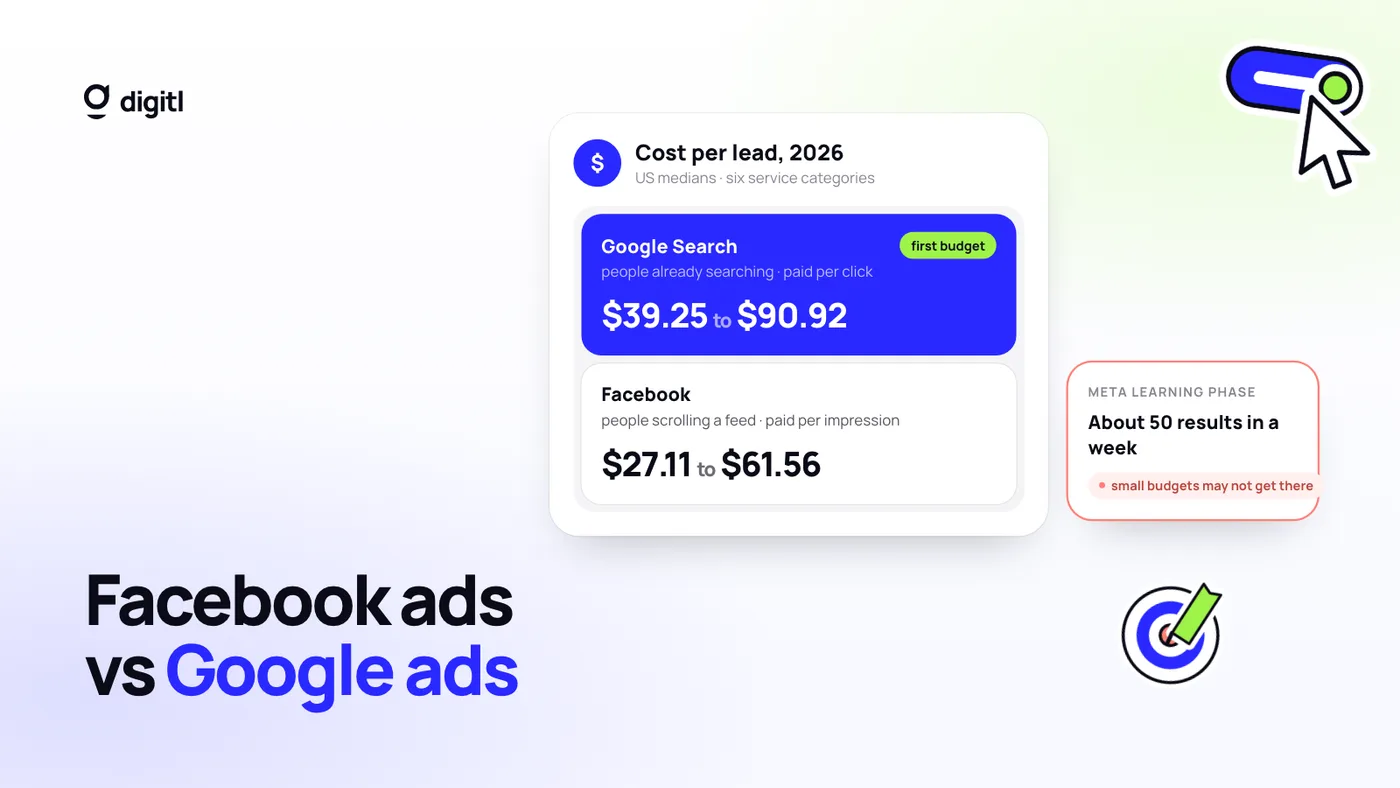
5 things to take awayFor Facebook ads vs Google ads for small business, Google Search usually gets the first budget, since it reaches people already searching.
Google Search charges per click. Many Meta objectives charge only for impressions, and a new Meta ad account spends its first $10 on impressions.
WordStream's 2026 US medians put a lead at $39.25 to $90.92 on Google search and $27.11 to $61.56 on Facebook, across six service categories.
Track calls and form fills on both platforms before you spend, or the two cost per lead figures can't be compared.
A Meta ad set leaves its learning phase after about 50 results in a week, which a small lead budget may never reach.
Google Search charges you when someone clicks your ad. On Meta, many campaign objectives can only charge for impressions, so a Facebook ad can cost money even when nobody taps it.
That difference follows from who sees each ad. For most local service businesses, the first budget belongs on Google Search, where people are already looking for a plumber or a cleaner this week. Facebook and Instagram ads suit work that sells on photos or an offer, and they tend to do best as the second platform, once calls and forms are tracked.
Choose Google Search ads if people in your area search for your service and someone can answer the phone when they call. Choose Facebook ads if your work sells on before-and-after photos or a recurring offer. Meta is also the better first test when too few people in your town search for what you do.
Run both once one platform brings tracked enquiries at a cost you can live with.
| Google Search ads | Facebook and Instagram ads (Meta) | |
|---|---|---|
| Who sees the ad | People searching for the service now | People scrolling a feed, chosen by audience settings |
| What you pay for | Each click | Impressions on many objectives, link clicks on some |
| Lead-based option | Local Services Ads (US), paid when a customer gets in touch | Lead ads with instant forms, no website needed |
| Cost per lead, 2026 US medians, six service categories | $39.25 to $90.92 | $27.11 to $61.56 |
| What it needs from you | A landing page per service and call tracking | Photos or video, an offer and fast follow-up |
| Best first for | Emergency and planned trades, cleaning, clinics | Visual work, recurring offers, small towns |
| Weak spot | Volume is capped by how many people search | Colder leads, and a learning phase that needs volume |
Send us your trade and your town, and we'll tell you which platform we'd test first. Book a call.
What is the difference between Facebook ads and Google ads?
Google Search ads answer a search someone has just typed, while Facebook ads appear in a feed to people who weren't looking for you.
Search intent is the need a person has at the moment they type a query, and a Google Search ad is built to meet it. In Google's own description of Search campaigns, the ads go to people actively searching online for your products and services.
Say a pipe bursts under a kitchen sink at 11 pm. The person types "emergency plumber near me", sees your ad above the map and calls within a minute or two, which is about as close to a booked job as advertising gets.
Meta works the other way round. Its ads run across Facebook, Instagram, Messenger and the Meta Audience Network, and the advertiser decides who sees them by defining a target audience. The ad then competes for a slot in someone's feed while they scroll past friends' photos and news.
That person may need a deep clean next month, or may never need one.
So Google reaches a small number of people who are ready to book, and Meta reaches far more people, few of whom need the service this week. On Google the demand is already there when your ad shows. On Meta the ad has to create the wish to book, which takes a sharper offer and better pictures.
For an owner with a modest first budget, this matters more than any cost per lead figure, and it's the first question we'd ask about your trade.
How does each platform charge you?
On Google Search you pay when someone clicks, while many Meta objectives bill you for impressions, with link clicks or video views as options on some.
On Google, cost-per-click bidding means you pay for each click on your ads. Every search starts an ad auction, and Google weighs your bid alongside the quality of your ad and landing page when it decides which ads show. Your maximum bid is a ceiling, and Google says you're often charged less, sometimes much less, than that ceiling.
For how a daily budget plays out over a month and how to size it from what one customer is worth, see how much a small business should spend on Google Ads.
On Meta, the charge choice in each ad set decides which event takes money from your budget, such as a link click or part of a video watched. The choices depend on the objective, and some objectives only charge for impressions. A new ad account also has to spend at least $10 on impressions before it can switch to anything else.
Meta's auction picks the ad with the highest total value, subject to a minimum price. That value combines your bid with two estimates Meta makes: how likely this person is to act, and how good the ad is. Meta also says you control total spend through the budget and cost per result through the bid strategy you choose.
Both platforms sell enquiries more directly too. In the US, Google's Local Services Ads let a business pay only when a customer gets in touch from the ad.
Meta's lead ads with instant forms collect a name and number without the person leaving Facebook or Instagram. Meta may prefill those details from what the person has already given it, so a form takes seconds. Meta offers a "higher intent" form type next to the default "more volume" one, and for a service business we'd start with higher intent.
| Google Search | Meta | |
|---|---|---|
| You pay for | Each click | Impressions on many objectives, link clicks or video views on some |
| Price control | A maximum bid, often charged less | A budget plus a bid strategy for the chosen result |
| Lead option | Local Services Ads in the US, paid per customer contact | Instant form lead ads, contact details often prefilled |
| Watch for | Landing page quality feeds into the auction | New accounts pay for their first $10 of impressions |
Boosting a post is the quickest way into Meta, and it's fine for a first look at the platform. Meta itself calls buying from your Facebook Page the simplest way to buy ads, with fewer options than Ads Manager. If you boost from the Facebook app on an iPhone or iPad, Apple's 30% service fee may apply, so buy boosts from a computer.
What does a lead cost on Facebook vs Google?
In WordStream's 2026 benchmarks, a lead cost $66.69 on Google search and $27.39 on Facebook across all industries, both US medians.
The Google figures come from WordStream's 2026 Google Ads benchmarks, published in May 2026. They cover 13,474 US search campaigns in Google Ads and Microsoft Ads, run from April 2025 to March 2026.
The Facebook figures come from WordStream's 2026 Facebook ads benchmarks, published in September 2026. That report draws on 452 US leads campaigns run from April 2025 to June 2026. Both reports give medians, which stops a few extreme accounts from pulling the figure up or down.
| WordStream category | Google search, cost per lead | Facebook leads campaigns, cost per lead |
|---|---|---|
| Home and home improvement | $90.92 | $42.95 |
| Personal services (includes cleaners) | $54.60 | $38.09 |
| Dentists and dental services | $72.97 | $61.56 |
| Physicians and surgeons | $40.04 | $32.14 |
| Health and fitness | $67.36 | $27.11 |
| Beauty and personal care | $39.25 | $50.91 |
| All industries | $66.69 | $27.39 |
Across these six categories, a Google lead runs from $39.25 to $90.92 and a Facebook lead from $27.11 to $61.56. Facebook comes out cheaper in five of the six.
Beauty and personal care goes the other way, with a Facebook lead at $50.91 against $39.25 on Google. Cleaners sit in WordStream's personal services category, where the Facebook cost per lead rose 24.60% in a year.
A benchmark counts every lead the same, so a prefilled form from someone half-interested and a call from someone with water on the kitchen floor are one lead each. The figure that decides the platform is cost per booked job, which is your spend divided by the jobs that came from it.
We treat a prefilled Facebook lead as a weaker signal than a call from a search. The person tapped submit, but they typed nothing, and some won't pick up when you ring back an hour later.
Both reports use US data and neither covers UK lead costs, so a UK business should read the ranges as a direction and expect its own figures to differ.
Why track calls and forms before you spend anything?
Without tracking, neither platform can tell you what a lead cost, and both will optimise towards whatever event they can see.
Google calls a conversion action a specific customer activity that's valuable to your business, and for most service firms that activity is a phone call. Google Ads can track calls from call ads and call assets, and calls to a Google forwarding number shown on your website after an ad click.
The simplest option, a tap on the number on your mobile site, counts the tap only. Google can track only those clicks, so the phone calls themselves stay invisible. Calls you track elsewhere, in a call tracking tool or a CRM, can be imported into Google Ads.
On Meta, the Meta Pixel is code on your site that measures what people do there after seeing an ad. The Conversions API sends events from your server or CRM, and it accepts phone and offline events as well.
Tracking matters more on Meta, where an ad set leaves the learning phase after about 50 results in the week after its last significant edit. Until then, results are less stable and usually cost more.
At the 2026 home and home improvement median of $42.95 a Facebook lead, 50 leads in a week comes to about $2,150. Few first budgets reach that.
So a small Meta test either optimises for a cheaper event that happens more often, or it lives with a longer and shakier start. Do you know which event your campaigns optimise for today?
In the UK and the EEA, Google's EU user consent policy requires disclosures to visitors and their consent. Under advanced consent mode, Google tags send cookieless pings while consent is denied, so your cookie banner shapes how much each platform sees.
Before the first ad goes live, we'd want four things in place:
Our paid advertising work starts with understanding the business and planning which searches and audiences to test. We set up conversion tracking before any ad runs, then we optimise, and each month you get a report with the cost per enquiry for every channel. Google Ads, Meta and TikTok ads run in the same process, so their figures sit side by side. We don't promise a number of enquiries, since that depends on your market and how fast you answer. Our paid advertising service covers Google and social ads, with the management fee kept separate from your ad spend.
Book a call, and we'll check whether your calls and forms are tracked before you spend a pound or a dollar.
Which is better for a cleaning company, a trades business or a clinic?
Google Search is the better first platform for emergency trades and most clinics, while cleaning and planned trades can test Meta second.
| Business type | First platform | Why | Test second |
|---|---|---|---|
| Emergency trades (plumbing, electrical, locksmith) | Google Search | The customer searches and calls within minutes | Meta for past visitors only |
| Planned trades (painting, kitchens, landscaping) | Google Search | Buyers compare quotes over weeks | Meta with before-and-after photos |
| Domestic and office cleaning | Google Search | One-off cleans start with a search | Meta for regular-clean offers |
| Clinics (dental, physio, aesthetics) | Google Search | Patients search by treatment and area | Meta, with care over tracking |
An emergency is the clearest case for Google, and the one where we'd put every pound or dollar into Search. Nobody scrolls Instagram hoping to find a locksmith, and a call from a search can turn into a job the same evening.
Planned trades are decided slowly. A kitchen or a garden takes weeks to choose, so a Meta ad showing a finished job can reach the buyer early while Google catches the search that comes later.
Cleaning sits between the two. One-off cleans usually start with a search, and regular cleans can be prompted by an offer. In WordStream's personal services category, which includes cleaners, a Facebook lead still cost less than a Google one in 2026, at $38.09 against $54.60.
When we rebuilt the site of a cleaning company in Jacksonville, Florida, it became forty-four pages, one for every service, every city and every question a customer types before booking. Pages like those give each Google ad a landing page that matches the search, and landing page quality is one of the factors in Google's auction.
Clinics need more care on Meta. Meta doesn't allow health information to be shared through its Business Tools, and breaking those terms can lead to data restrictions or a suspended account.
In the US, HHS guidance on online tracking treats sending patients' health information to tracking vendors for marketing, without their authorisation, as an impermissible disclosure. A federal court vacated part of that guidance in June 2024, and HHS says it is evaluating its next steps. For a dental or physio practice, we'd keep the pixel off booking and treatment pages and start on Google Search.
When should you run both?
Run both once the first platform brings tracked enquiries at a cost per booked job you can afford, and the budget can feed both.
How much that budget needs to be depends on what a customer is worth to you. Splitting a small budget across both platforms too early leaves each one short of the data it needs, and Meta's learning phase makes that worse.
The two platforms help each other when someone who clicked a Google ad and left without calling sees a Meta ad later, through a website custom audience built from Meta Pixel events.
Meta also suits seasonal pushes, such as spring cleans or boiler checks before winter, while Google keeps catching the searches that arrive anyway.
Compare the two with care, since Meta credits an action to an ad when it happens within a set number of days after someone viewed or clicked it. The same booking can then show up in both dashboards.
Count bookings in your own CRM and split them by where the customer came from. When we add Meta to a running Google account, we'd leave Google untouched for the first month, so any change in enquiries has one cause.
Who should switch
Owners who boost posts and get likes but few calls should move budget to Google Search, and Google advertisers in small towns should test Meta.
If you boost posts today, open last month's call log and count the calls those boosts brought in. Likes on a boosted post show attention, which is a slow route to a booked job. Google Search, with call tracking, will tell you within weeks whether people in your area are looking.
If you run Google only, two signs point to adding Meta. Your campaigns spend less than their budget because too few people search in your area, or your work sells on photos that a text ad can't show.
Some businesses should stay on one platform for now. With a very small budget, one platform done properly beats two done halfway. The same goes for any business that can't yet track calls and forms, since a second platform would only add a second set of numbers nobody can check.
What you trade is speed against reach. Google brings fewer and warmer enquiries, while Meta puts more people in view at a lower price per lead and leaves more of the follow-up to you.
Frequently asked questions
1. Is Facebook advertising worth it for a small business?
Facebook advertising is worth it when your work sells on photos or an offer and you can call leads back fast. In WordStream's 2026 data, Facebook leads cost less than Google leads in five of six service categories. Judge it on booked jobs, since prefilled form leads are quick to send and easy to forget.
2. Which is cheaper, Facebook ads or Google ads?
Facebook is usually cheaper per lead. The 2026 all-industry medians were $27.39 on Facebook and $66.69 on Google search, both from WordStream's US data. Google leads tend to arrive closer to booking, though, so cost per booked job can come out closer than the lead prices suggest. Track both before you decide.
3. Can you run Facebook ads without a website?
Yes. Lead ads with instant forms collect a name, a phone number and your own questions inside Facebook or Instagram, and Meta may prefill the contact details. You'll still need a privacy policy link, and you'll need a fast way to call each lead back. A website helps later, when you want to retarget visitors.
4. How long should you test before deciding?
Test long enough to count booked jobs, which usually takes several weeks. On Meta, wait until the ad set leaves its learning phase, which takes about 50 results in a week. Avoid big edits during that time, since Meta says they reset learning. On Google, judge by tracked calls and bookings.
5. Do boosted posts count as Facebook ads?
Yes. A boost is a Meta ad bought from your Page, with fewer settings than Ads Manager. It can work for reach, but Ads Manager gives you lead forms, conversion goals and fuller audience controls. If you boost from an iPhone or iPad app, Apple's 30% service fee may apply, so boost from a computer.
What to do next
If people in your town search for your service, start with Google Search and tracked calls. Add Meta once Google brings booked jobs at a cost you can carry, and when you have photos or an offer worth showing. Start with Meta first only when search volume in your area is too small, or when your work sells on how it looks.
Whichever you choose, count bookings by source from the first week, so the next decision rests on your own numbers.
Tell us your trade, your town and your monthly budget, and we'll say which platform we'd test first. Send us a message.
Written byLuka
Have a question about this topic?
The first call is free.