How much does branding cost for a small business in 2026
How much does branding cost for a small business? What it covers beyond a logo, which files and rights to own, and when a logo is enough.
LazarBrand15 min read
Key takeaways
5 things to take awayHow much does branding cost for a small business depends on scope, from a $249 marketplace logo package to the designer hours a guide takes.
Branding covers the written decisions and owned files behind how your business looks and talks, and your logo is one of those files.
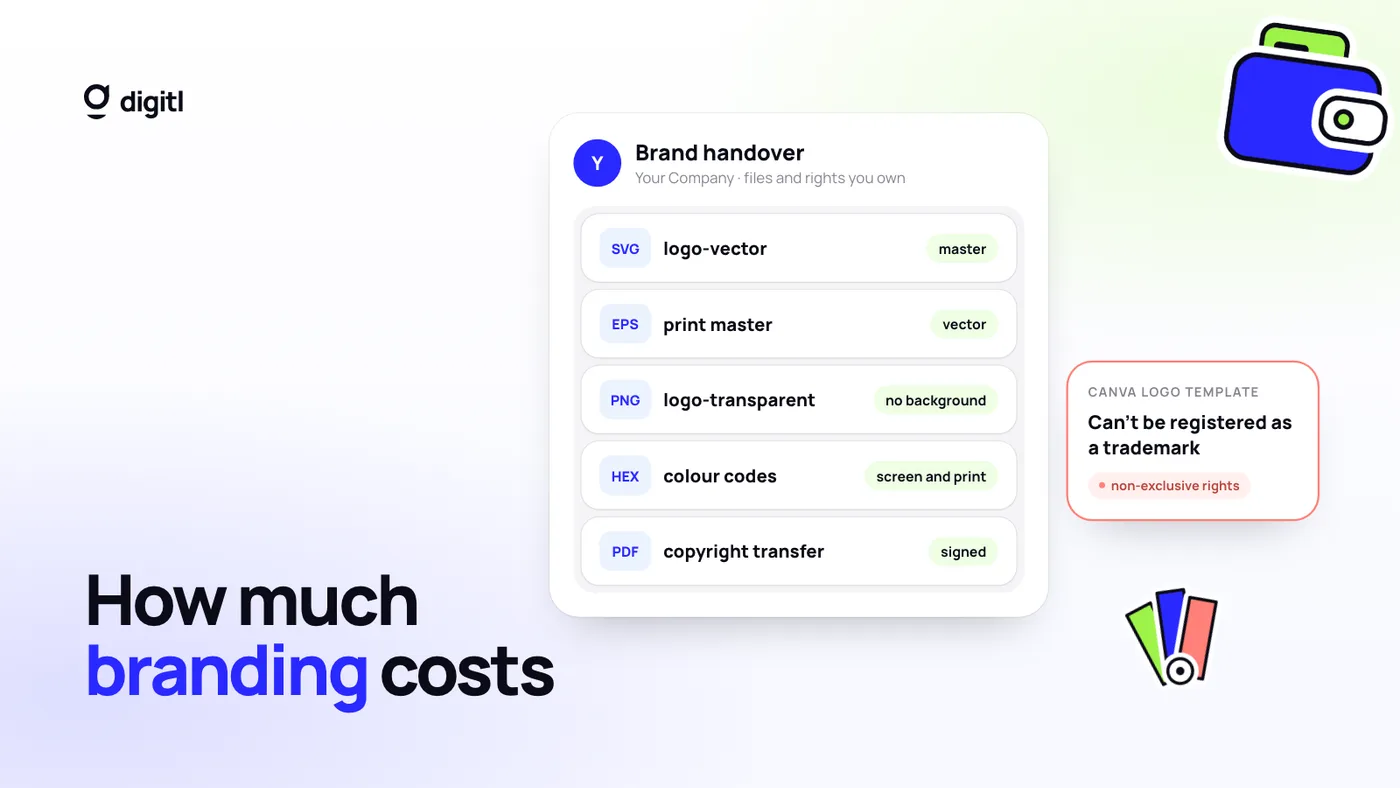
Leave the handover with SVG and PDF or EPS vector masters, transparent PNGs, screen and print colour codes and a signed copyright transfer.
If your logo comes from a Canva logo template, Canva says your rights are non-exclusive and you can't trademark it.
Filing a trademark costs $350 per class at the USPTO, or £205 online at the UK IPO plus £60 per extra class.
If your logo started as a Canva template, Canva's own help centre says you can't register it as a trademark. Your rights to it are non-exclusive too, so anyone can use the same design.
What you pay for branding follows the scope. A logo package on 99designs' price page costs $249 to $1,050, while a full brand with a guide is priced by the hours it takes.
Those hours are paid at a US median designer wage of $30.27 an hour, according to the Bureau of Labor Statistics. A logo alone is enough while one person makes everything, and past that point the money goes on the rules and files around the logo.
What is branding, and how is it different from a logo?
Branding is the set of written decisions and owned files that tells anyone making something for your business how it should look and what it should say. The logo is one of those files.
Each part of the work settles one question for whoever picks up your brand after the designer has gone.
- Positioning decides who the business is for and what it should be known for locally.
- The name and message set what you're called and the lines you repeat on every quote.
- The logo is the mark itself, with versions for dark backgrounds and small sizes.
- Colours and type pin down the exact colour codes and fonts.
- Templates turn those rules into reusable files, such as a quote or a social post.
- The brand guide writes it all down for a printer or a new hire.
A logo on its own only settles what the mark looks like. Your sign-maker still chooses the font on the van, and whoever writes the next ad chooses the wording.
You feel the logo vs branding gap through your suppliers. With only a logo, each of them makes small decisions for you, and after a year of flyers and a van wrap those decisions rarely match. Do your van and your last flyer use the same font?
| Logo only | Full branding | |
|---|---|---|
| What it covers | The mark, often in one or two files | Positioning, name and message, logo, colours, type, templates and a guide |
| What a printer can work from | A logo file, sometimes only a PNG | Vector files, print colour codes and spacing rules |
| What a new hire can follow | Nothing written down | The guide and ready-made templates |
| Who decides how the next flyer looks | Whoever makes it | The guide |
We'd write the positioning and the message before anyone opens a design tool. A logo drawn before those two exist tends to get redrawn once they do, and you end up paying for the same drawing a second time.
How much does branding cost for a small business?
Branding a small business costs from $249 for a marketplace logo package up to whatever design hours a full guide and templates take.
99designs lists four logo packages at $249 (Bronze), $399 (Silver), $799 (Gold) and $1,050 (Platinum), excluding sales tax. Those packages buy a logo and nothing else.
Anything past the mark is priced by the time a designer or strategist spends on it, so read the hours on a quote before its headline figure.
The Bureau of Labor Statistics gives US graphic designers a median annual wage of $62,960 in May 2025, which works out at about $30.27 an hour. The same page says 20% of US graphic designers are self-employed, so your quote may well come from a freelancer working on their own.
In the UK, the National Careers Service puts graphic designer salaries at £25,000 for a starter and £40,000 for an experienced designer. Expect a freelancer's day rate to sit above what those salaries come to per day, since the rate also has to cover the weeks with no paid work.
| Scope | Who does it | What it includes | Price or cost basis |
|---|---|---|---|
| DIY | The owner | A logo from shapes and licensed fonts, colours picked by eye | Your time, plus any paid plan on the tool |
| Logo only | A marketplace seller or a freelance designer | Logo concepts and the final logo files | $249 to $1,050 on 99designs' logo packages, read 17 November 2026 |
| Logo plus visual identity | A freelance designer | Logo, colour codes, fonts and a few templates | Designer hours times the rate; depends on the brief and the scope |
| Full branding with a guide | A studio, an agency or a senior freelancer | Positioning, message, identity, templates and a brand guide | Strategy and design hours times the rate; depends on the brief and the scope |
You can test any quote with one sum. Say a quote for a logo plus identity lists 30 hours of design time. At the US median wage, the designer's pay alone comes to about $908.
A quote of a few hundred dollars for that scope is leaving something out. A studio's figure sits higher again, since it adds a strategist's time and its overheads on top of that floor.
Six things move the number of hours.
- The number of logo concepts you see.
- The revision rounds included in the price.
- Research and positioning before any design.
- How many templates you get, and in which tool.
- How deep the brand guide goes.
- Whether the files cover print as well as screen.
We'd put the money into templates before extra concepts. You look at a third logo concept once, and you open a quote template every week.
Book a call with your current logo and a few flyers or quotes you've printed, and you'll leave with a written scope you can take to any designer.
How much does a logo cost on its own?
On its own, a logo costs anything from an afternoon in a free tool to $1,050 for the top 99designs package, before you file a trademark.
The cheapest route is a design tool with free content. Next up is a marketplace package at one of the four prices on 99designs' page.
A freelance designer usually quotes a fixed fee or the hours, and the BLS median lets you check whether those hours are priced sensibly.
Lower prices usually leave out the work around the mark.
- Rules for colour and type, so the next supplier doesn't guess.
- Versions for dark backgrounds, one-colour printing and small sizes such as a profile picture.
- The vector files a sign-maker or embroiderer asks for.
Two quotes of $400 can differ by a whole set of files, so the price alone tells you little. Before you compare them, ask each designer to put in writing what you'll receive and who'll own it.
Which files and rights should you get?
A complete handover gives you files that both your printer and your web developer can use, plus a signed document that transfers the copyright to you.
Ask for these files at handover:
Templates matter most once someone else makes your posts. If you're weighing that step, here's what a social media manager costs per month. We'd have the templates ready before that person starts.
Paying for a logo doesn't make you its owner. Under US law, copyright vests initially in the author of a work, and the author here is your designer.
A commissioned work counts as a work made for hire only in the categories US law lists, and only if both sides agree to it in a signed written instrument. Any other transfer of copyright is valid only in writing signed by the owner of the rights.
UK law starts from the same rule. The Copyright, Designs and Patents Act 1988 makes the author the first owner unless an employee made the work in the course of employment.
A freelance designer is not your employee. Under section 90 of the same Act, an assignment of copyright has effect only in writing signed by or for the designer.
In the contract, look for a clause that assigns all copyright in the final logo and identity files to your business. Check that the designer signs it, and note what happens to the concepts you didn't choose.
Fonts work differently, since you only ever license a font. Google Fonts' FAQ says its fonts can be used commercially and in any logo, which settles the font question on a lower budget.
At Digitl, branding is part of your whole marketing function, run as one system. We plan it in the same process that runs your site and your ads, so the colours and lines in your posts match the ones on your landing pages.
We start with positioning and the brand story. The logo and visual identity come next, and the brand book and templates close it, built for whatever you print or post most. It's the same team behind 50+ companies we've helped grow, and the branding service page sets out each stage.
Send us a message at hello@digitl.me with a photo of your current logo on whatever you use most, and we'll tell you which of those stages your business needs first.
Can you make your own logo in Canva?
You can, but Canva's help centre says a logo made from one of its logo templates gives you non-exclusive rights and can't be registered as a trademark.
The rule comes from Canva's Content License Agreement, which bars using any of its content as part of a trademark or a business name. Fonts are the one exception.
The same agreement grants its Free Content on a non-exclusive basis. Any other Canva user, a competitor down the road included, can put the same elements into their own designs.
A Canva logo can still be registered in one case. Canva's help page on trademarks and logos says a logo built from scratch with simple lines and shapes from its Free library can be registered. Any of its fonts can go into that logo, while its stock photos and graphics can't.
Canva also doesn't sell exclusive rights to a graphic, and the same page points you to a graphic designer instead.
A DIY logo is a sound way to test a name on a first van or a stack of flyers before you spend anything on a designer. It stops being enough the day you want to register the mark or stop a competitor using something similar.
If you build it yourself, make it easy for a designer to take over later.
- Start from plain shapes and a font you can license, such as a Google Font.
- Leave out stock icons and template layouts.
- Keep the original design file, so a designer can redraw it as a vector later.
How much does it cost to trademark a logo in the US and UK?
The USPTO charges $350 per class for a base application, and the UK IPO charges £205 to apply online for one class plus £60 for each extra class.
| Fee | US (USPTO) | UK (IPO) |
|---|---|---|
| Application, first class | $350, filed electronically | £205, filed online |
| Each extra class | $350 | £60 |
| Fee in force since | 19 January 2025 (schedule revised 1 November 2026) | April 2026 |
The USPTO fee schedule adds surcharges on top of the base fee. An application filed with insufficient information pays $100 more per class.
Describing your goods and services in the free-form text box instead of the Trademark ID Manual costs $200 more per class. Each further 1,000 characters adds another $200. Pick your descriptions from the manual and that surcharge never applies.
The UK IPO's forms and fees page lists £205 for an online application, a fee that rose from £170 on 1 April 2026. The IPO's full list of fees puts each additional class at £60, up from £50.
A UK mark with no issues is usually granted about 3 to 4 months after you apply, according to GOV.UK.
The form you file in decides what that fee protects. The USPTO defines a trademark as any word, phrase, symbol or design that identifies your goods or services, or a mix of them.
A name filed in standard characters gets the broadest protection, in any lettering. A logo filed as a special form is, in the USPTO's own words on mark drawings, "protected only for the particular depiction you provided."
That's why we'd protect the name before you pay for a final logo. The filing still covers it when the lettering changes at the next redesign.
Search before you file. The UK IPO's search service shows whether a similar mark already exists in the UK, and a clash found after the van is wrapped costs far more than the search.
How much does a rebrand cost?
A rebrand's design fee is one line of the bill, and changing a UK company name adds an official fee of £20 online at Companies House.
The rest of the bill is everything that carries the old look. Walk round your premises and vans and write it down, since that list is the most accurate estimate you'll get.
- Signs on the premises and on site boards.
- Vehicle wraps and magnets.
- Uniforms and workwear.
- Printed stock such as cards, quote pads and leaflets.
- The website.
- Social profiles and their cover images.
- Business listings and directory entries.
The website can be the largest line. If yours needs rebuilding or reworking to match, what a small-business website should cost in 2026 gives you the three-year totals to put on that line.
A name change adds official costs on top. Companies House charges £20 to change a company name online, £30 on paper and £85 for a same-day change. In the US, the filing and its fee depend on the state where the business is registered.
Run the work in the wrong order and you pay twice, so check the name and the mark first. Design comes next, and printing waits until the files are final and you own them.
When is a logo enough, and when isn't it?
A logo is enough while one person makes everything the customer sees, and full branding pays once several people or suppliers make materials for you.
| A logo is enough when | Full branding pays when |
|---|---|
| One person makes every flyer, post and quote | Several staff or suppliers make materials |
| The business uses one or two channels | Ads run on several channels at once |
| Most work comes from referrals | You're opening a second location |
| You have no plan to trademark the name or hire | You're preparing a franchise or a sale |
| Few local competitors share your trade and look | The local market is crowded, or your name clashes with another firm's |
Full branding is not for a business still testing its name or its offer. If the name might change in six months, a clean DIY logo and a trademark search are the better spend until the name and offer settle.
If your business sits between the two columns, how many people and suppliers made something with your logo on it last year? If it was more than one, we'd put a written guide ahead of the next print run.
What to do next
Write down the scope you need before you ask anyone for a price. Put these on the list:
- the decisions you want settled;
- the files you need to own;
- the rights, in writing;
- whether the name should be trademarked.
Then ask each designer or studio to quote against that same list, and compare the hours each of them puts against the parts you need.
If a quote can't say which files you'll own and who signs the copyright over, it isn't a complete quote yet.
Book a call and we'll turn your list into a scope with stages, so you know what each part of your brand will cost before you commit.
Written byLazar
Have a question about this topic?
The first call is free.