How much should a small business spend on Google Ads?
How much should a small business spend on Google Ads? Work it out from customer value and close rate, then test it against 2026 cost per lead data.

LukaAdvertising18 min read
Key takeaways
5 things to take awayHow much should a small business spend on Google Ads? Multiply your allowable cost per lead by the enquiries you want each month.
Allowable cost per lead is the gross profit from one customer multiplied by your close rate, minus the margin you keep back.
Google can spend up to twice your average daily budget on a single day, but a month's charges stay within 30.4 times that budget.
Local Services Ads charge per valid lead, and Google Verified replaced the Google Guaranteed and Google Screened badges from October 2025.
A management fee pays for the hours spent running your account, and the ad budget is separate and goes straight to Google.
Your invoices already hold most of your Google Ads budget. They show what one customer is worth to you, and how many of the people who ring or fill in a form end up paying.
No single figure suits every business. What a small business should spend on Google Ads is the most it can afford to pay for one enquiry, multiplied by the enquiries it wants each month. A dated benchmark cost per lead then tells you whether that figure holds up in your trade. In some US and UK trades, Local Services Ads are the cheaper first test.
How Do You Work Out a Google Ads Budget Backwards?
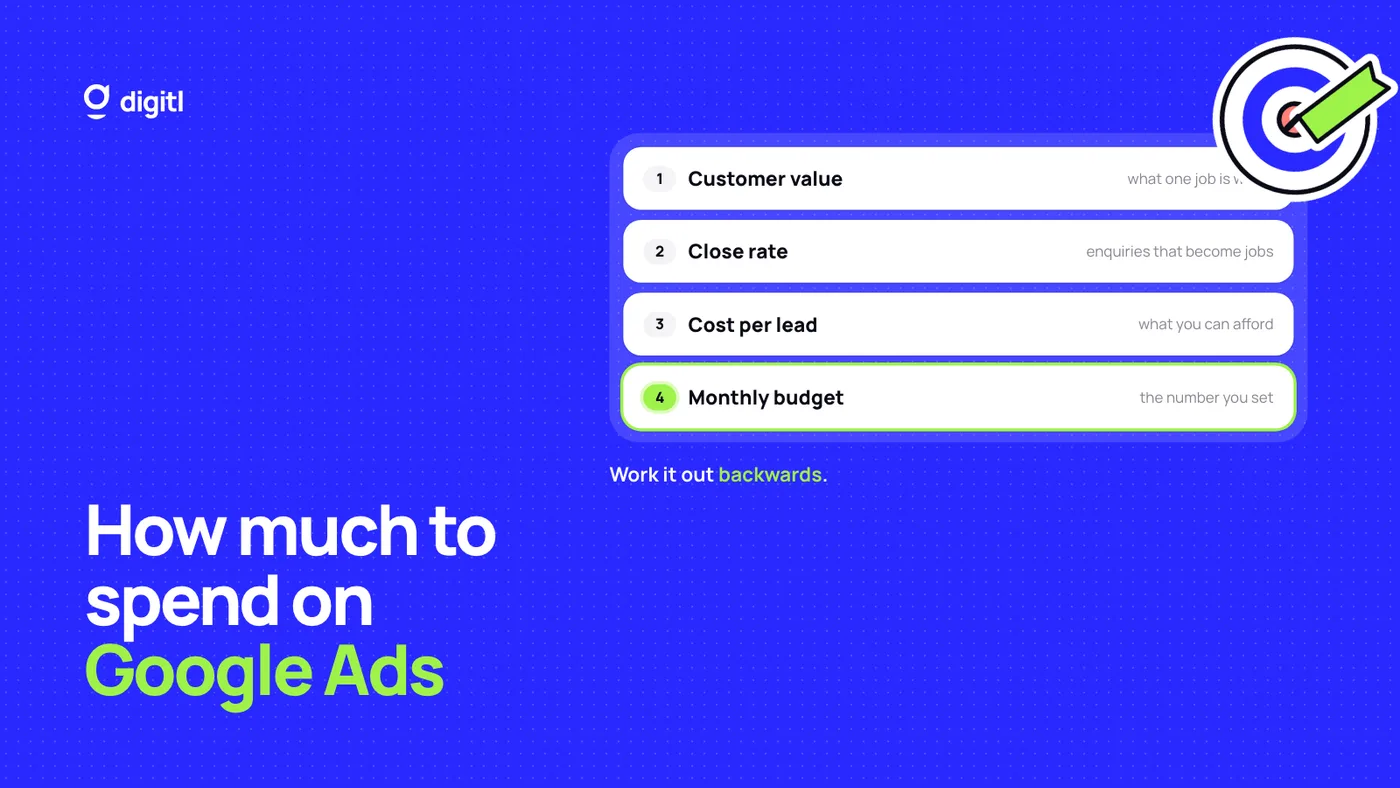
Customer value times close rate gives the most you can pay for one enquiry, and that figure times the enquiries you want is your budget.
Allowable cost per lead is the highest price you can pay for one enquiry that still leaves a profit on the jobs you win. Every other figure in your budget follows from it.
Google starts in the same place. Its guide to what Google Ads costs, from September 2026, tells advertisers to estimate what each conversion is worth from order value and closing rate. You then adjust that for retention and for what the service costs you to deliver.
It takes four steps:
- Customer value is the gross profit from one customer. Count it on the first job for one-off work, or over a year for repeat work such as regular cleaning.
- Close rate is the share of enquiries that turn into paid work.
- Allowable cost per lead starts at customer value times close rate, which is the break-even price of one enquiry. You keep part of that back as profit.
- Monthly budget is allowable cost per lead times the enquiries you want each month.
Say a regular cleaning client brings you $1,200 of gross profit a year and you win 1 in 4 enquiries. Worked through, that looks like this:
| Step | What you need | Example |
|---|---|---|
| 1 | Gross profit from one customer | $1,200 a year from a regular cleaning client |
| 2 | Close rate | 1 in 4 enquiries, or 25% |
| 3 | Break-even cost per lead | $1,200 x 25% = $300 |
| 4 | Allowable cost per lead, keeping half back | $150 |
| 5 | Monthly budget for 10 enquiries | $150 x 10 = $1,500 |
Use gross profit in step 1. Revenue makes the budget look bigger than it is, since wages and supplies come off every invoice before anything is left for advertising.
Most estimates go wrong on the close rate. Owners remember the jobs they won and forget the quotes that went quiet, so count it from real calls and forms over the last three months. How many of last quarter's quotes did you actually chase?
How much you keep back in step 4 is your call. We'd start at half the break-even figure, which leaves room for a slow month and for the weeks a new campaign spends learning which searches bring work.
One-off work leaves less to spend. Say a boiler repair leaves you $400 of gross profit and you win 1 in 3 enquiries. Break-even is then about $133, and keeping half back puts your allowable cost per lead at about $67.
With one-off work there's no year of repeat visits to spread that cost over. A trade built on one-off jobs needs a higher close rate or a bigger first invoice before the same budget makes sense.
Try it with your own numbers, or start from either example:
Answer the three questions in our three-question plan, then bring your allowable cost per lead to the first call so we start from your numbers.
What Does Google Ads Cost per Lead for Service Businesses?
In LocaliQ's 2026 benchmarks, the average search ad lead cost $66.69 across all industries and $90.92 for home and home improvement businesses.
The figures come from LocaliQ's 2026 search advertising benchmarks, published in May 2026 and built from thousands of LocaliQ customers' campaigns on Google Ads and Microsoft Ads. The data is American. The same report found that average cost per lead fell across all industries in 2026 for the first time in five years.
These are the categories closest to a small service business:
| Category | Average cost per lead | Average cost per click | Conversion rate | Data year |
|---|---|---|---|---|
| All industries | $66.69 | $5.42 | 8.18% | 2026 |
| Home and home improvement | $90.92 | $8.33 | 8.05% | 2026 |
| Cleaning and maid services | $46.99 | $8.50 | 17.65% | 2025 |
| Dentists and dental services | $72.97 | $8.00 | 10.67% | 2026 |
| Physicians and surgeons | $40.04 | $4.76 | 12.43% | 2026 |
The cleaning row comes from LocaliQ's 2025 home services benchmarks, published in June 2025. That report covers over 3,200 search campaigns run between April 2024 and March 2025, and it shows how far lead prices spread inside one sector.
Cleaning was among the cheapest home services at $46.99 a lead. A plumbing lead averaged $129.02, and air conditioning installation and repair sat close by at $127.74. Electricians came in at $93.69, while roofing and gutters topped the list at $228.15.
A roofer and a cleaner both sit under home services, yet the roofer pays nearly five times as much per lead. So check your own trade's row before you look at the sector average.
Clinics have their own report. LocaliQ's healthcare benchmarks, published in December 2025, put general dentistry at $84.77 a lead.
A benchmark averages many accounts, so use it to test your allowable cost per lead. The cleaning example's $150 sits well above the $46.99 average. The boiler repair lands at about $67, which is roughly half what a plumbing lead averaged in LocaliQ's US data.
If your allowable figure sits below your trade's average, Search will probably lose money until your site converts better or each customer is worth more to you.
Google's free Keyword Planner gets you closer to your own market, since it shows what clicks on your chosen searches have cost where you work. Google's Keyword Planner help page says its top-of-page bid range runs from about the 20th to the 80th percentile of what advertisers in your location paid over the last 30 days.
On a brand-new account it's less useful. Until Google has enough data on your own business, a new account's forecasts use historical averages for all advertisers.
Performance Planner, Google's tool for planning spend, can't help before you launch. Google's Performance Planner requirements ask for spend in the last 17 days and at least one conversion, so it only sizes a budget once a campaign is already running.
How Does Google Spend Your Daily Budget Each Month?
Your daily budget is an average, so one day can cost up to twice it, but a month never bills over 30.4 times it.
Google calls the setting an average daily budget, and you set it per campaign. Google Ads Help on average daily budgets describes it as roughly what you're comfortable spending each day across the month. Google then shifts spend towards the busier days.
That shifting has a ceiling. Google's page on overdelivery says a campaign can spend up to twice its average daily budget on a single busy day, and the monthly charging limit caps the month.
The limit is 30.4 times your daily budget, since 365 days divided by 12 months gives 30.4. Google's monthly spending limit page works through a $10 daily budget, which comes to a $304 monthly limit.
If served costs run past the daily or monthly limit, the same page says you still won't pay more than those limits.
That makes your Google Ads cost per month a number you choose. Divide the backwards budget by 30.4 to get the daily figure:
- The cleaning example's $1,500 a month becomes an average daily budget of about $49.
- On a busy day Google could spend close to $98.
- Across the month, the charges still stay within $1,500.
Watch a month fill at three budgets from this post:
Change the budget mid-month and Google's page on budget changes caps the rest of that month at the new daily budget times the calendar days left.
Next, check whether your budget buys enough clicks to tell you anything. Say you give a plumbing campaign $15 a day, about $456 a month. At plumbing's $10.49 average cost per click, that buys around 43 clicks.
At the 8.05% conversion rate for the broader home category, 43 clicks come to three or four enquiries a month. Three or four enquiries can't give you a reliable cost per lead, and a single quiet week with no calls would swing the figure either way.
On a small budget we'd put everything into one campaign on a few high-intent searches. Think "carpet cleaning near me", or the service plus your town.
Keep that campaign to the towns you actually drive to. Broad terms and extra regions can wait until it shows a cost per lead you can live with.
Is Google Ads Worth It for a Small Business?
Google Ads is worth it when your allowable cost per lead sits above your trade's average and every call and form is answered and counted.
Whether Google Ads is worth it for a small business comes down to measurement first. Google's guide says a lead business can make form submissions or phone calls the primary conversion a campaign works towards. Cost per lead then shows up as a number in the account.
Calls need their own setup. Google's help page on call conversions says a call can count as a conversion through Google's AI analysis of the recording, or by lasting longer than a minimum duration you pick.
Calls from your website run through Google forwarding numbers. Google's page on website call conversions explains that these replace your business number at no cost, so a call that started with an ad still gets counted.
Once the numbers hold up, a tight budget becomes the bigger risk. Google's own guide warns that capping the budget on a profitable campaign caps your profit too.
Whatever the budget, Google Ads is a poor fit for these businesses:
- A business that can't take more work this month.
- A business that can't answer the phone during working hours.
- A business that sends every click to a homepage with no service or area pages.
The last one is the most common, and the cheapest to fix. Someone who searches "end of tenancy cleaning" in their area should land on a page about end of tenancy cleaning in that area.
We rebuilt the site for Pando Cleaning Solutions, a cleaning company in Jacksonville, Florida, as forty-four pages. Every service and every city got its own page, and so did every question a customer types before booking.
With a structure like that, each ad gets a page that matches its search. The same pages pull in visits from organic search, where you don't pay per click, and that's the work our SEO service builds on.
What Does a Google Ads Management Fee Cover?
A management fee is what an agency or freelancer charges to run your account, billed separately from the ad spend you pay straight to Google.
The fee buys hours of work each month, and in a well-run account those hours go on these jobs:
- Choosing the searches and the areas to target.
- Writing ads and matching each one to a landing page.
- Setting up call and form tracking before launch.
- Reviewing the search terms each week and excluding the ones that bring nothing.
- A monthly report with spend and cost per enquiry.
Most figures quoted online as the average Google Ads management fee come from agencies describing their own prices. We'd treat them as sales copy and compare what each fee buys instead.
You'll usually see one of three structures. A flat monthly fee stays put whatever you spend, while a percentage of ad spend rises and falls with your budget. On top of either, some agencies charge a one-off setup fee for the build and the tracking.
Whichever model you're offered, ask for three things in writing.
At Digitl, paid advertising starts with measurement. We set up tracking for every way a customer can reach you, and we check that each one records before any ad goes live.
Then we pick the searches your customers actually type in the area you serve. Every week we go through the search terms and exclude the ones that bring no enquiries. Each month you get a report showing spend and cost per enquiry.
Our management fee is set separately from your ad budget, which you pay to Google directly, and you'll see it in the quote after a first call. We don't promise a fixed number of enquiries.
Local Services Ads vs Google Ads, Which Is the Cheaper Start?
Local Services Ads charge a verified business per valid lead, so for an eligible US or UK trade they're often the cheaper first test.
With Local Services Ads you pay when a customer gets in touch. Google's Local Services help on lead charges counts an answered call, a message or a voicemail as a lead. Booking requests count too, but only in the US and Canada.
Lead prices vary with location and job type, among other factors, the same page says. Under Google's Local Services bidding rules your bid is the most you'd pay for a lead, and the bids of competing local businesses set what you actually pay.
Switch between the two to see who you pay for:
The badges changed recently. Google announced Google Verified in August 2025 as the replacement for the older Local Services badges from October 2025.
Google Verified took over from Google Guaranteed and Google Screened, and the Money Back Guarantee went with them. Any guide still comparing the two old badges is out of date.
What you go through to get verified depends on where you work. Google's screening page says checks vary by category and region and may include licence, insurance and background checks.
Whether you can run them at all depends on your country and category. The UK category list covers home service trades such as cleaners and plumbers, but legal categories run in Greater London only. The US list includes house cleaning and dentists among many others.
You set a Local Services budget by the week. With Maximize leads bidding, Google recommends at least 10 leads a week, which is more than 40 a month. Can your diary take that many new jobs?
Check that number against your allowable cost per lead before you commit, since a one-van business may not want that much new work.
Here's how the two compare side by side:
| Local Services Ads | Google Search ads | |
|---|---|---|
| What you pay for | A valid lead, such as a call, message or booking | A click on the ad |
| Who sets the price | Bids from competing local businesses, by location and job type | Your bids against other advertisers |
| Setup and checks | Google Verified checks, which may include licence, insurance and background | An account, billing and conversion tracking |
| Control over searches | None, targeting comes from service categories and areas | Full, search by search, with exclusions |
| Best fit | Eligible trades that want leads without managing searches | Services Local Services doesn't cover, and owners who want control |
Local Services Ads also compete with Search ads on the same results page. LocaliQ's home services report links lower search ad conversion rates partly to searches like "plumber near me" now showing more ad types, Local Services Ads among them.
The product itself is changing as well. Google's migration notice says Local Services campaigns are moving into Google Ads as Performance Max campaigns with pay-per-lead goals, starting with select US home services in August 2026.
After the move you still pay per valid lead, and the campaign shows only on Google Search and Maps. You lose manual lead disputes and the option to set a maximum cost per lead by hand. Non-US accounts such as UK ones are down for 2027, and that date may still move.
Local Services Ads are out for a business whose category isn't on Google's list, or one that can't pass verification. Owners who want to pick the exact searches they show up on will find them frustrating too.
If your trade qualifies, we'd run Local Services first while the tracking for Search gets built. Search campaigns then pick up the services Local Services doesn't cover.
Frequently Asked Questions
1. What Is the Minimum Budget for Google Ads?
Google sets no minimum. Its guide to Google Ads costs says there's no flat fee or monthly subscription, so the amount is your call.
In practice the floor is whatever buys you a handful of enquiries a month at your trade's cost per lead. At cleaning's $46.99 average, ten enquiries would need about $470 a month.
2. How Long Before You Know if Google Ads Work?
It depends on how many enquiries come in, more than on how long the campaign has run. A campaign bringing one enquiry a day shows a usable cost per lead within a few weeks.
One bringing three or four a month needs months before its cost per lead means much, so a small budget is slow to judge.
3. Do You Pay for Spam Calls With Local Services Ads?
In the US, mostly no. Google filters out spam and duplicate contacts, then keeps checking each lead for 30 days and credits poor ones automatically.
The UK works differently. Google's lead credit page says credits aren't available to advertisers in EMEA, which includes the UK, or in health care categories. Manual disputes end once the account moves into Google Ads.
4. Can You Run Local Services Ads and Google Ads at the Same Time?
Yes, and Google suggests it. Google's page on pay-per-lead campaigns recommends running them alongside Search and other campaign types.
With both running, you can appear in more ad placements on the same results page. Judge each one by its cost per lead, then move money towards whichever brings enquiries you can afford.
5. Is a Percentage of Ad Spend a Fair Management Fee?
It can be, though it ties the fee to your spend. Double the budget and the fee doubles, even when the weekly work stays the same. Before you sign, ask what work the fee buys each month and whether the ad account is in your name.
6. Does Google Charge You if It Spends Over Your Budget?
Only up to its limits. A single day can cost up to twice your average daily budget, but the month is capped at 30.4 times it. If served costs go past the daily or monthly limit, Google's monthly spending limit page says you won't pay more than that limit.
What to Do Next
Start from your own numbers, then let the benchmark decide your first step.
See how we run Google Ads on our paid advertising page, then send us a message with your close rate and customer value and we'll book a call to work through your budget.
Sources
- Google, How much does Google Ads cost, 22 September 2026, https://business.google.com/us/resources/articles/how-much-google-ads-cost/
- LocaliQ, Search advertising benchmarks, 26 May 2026, https://localiq.com/blog/search-advertising-benchmarks/
- LocaliQ, Home services search advertising benchmarks, 9 June 2025, https://localiq.com/blog/home-services-search-advertising-benchmarks/
- LocaliQ, Healthcare search advertising benchmarks, 22 December 2025, https://localiq.com/blog/healthcare-search-advertising-benchmarks/
- Google Ads Help, Keyword Planner statistics, undated, https://support.google.com/google-ads/answer/3022575?hl=en
- Google Ads Help, About Performance Planner, undated, https://support.google.com/google-ads/answer/9230124?hl=en
- Google Ads Help, About average daily budgets, undated, https://support.google.com/google-ads/answer/6385083?hl=en
- Google Ads Help, About overdelivery, undated, https://support.google.com/google-ads/answer/1704424?hl=en
- Google Ads Help, Monthly spending limit, undated, https://support.google.com/google-ads/answer/10486637?hl=en
- Google Ads Help, Changing your budget mid-month, undated, https://support.google.com/google-ads/answer/10487143?hl=en
- Google Ads Help, Call conversions from ads, undated, https://support.google.com/google-ads/answer/6095882?hl=en
- Google Ads Help, Call conversions from your website, undated, https://support.google.com/google-ads/answer/6095883?hl=en
- Google Local Services Help, How you're charged for leads, undated, https://support.google.com/localservices/answer/7195435?hl=en
- Google Local Services Help, Bidding for leads, undated, https://support.google.com/localservices/answer/10125017?hl=en
- Google, The Keyword blog, Google Verified, 20 August 2025, https://blog.google/products/ads-commerce/google-verified-august-2025/
- Google Local Services Help, Screening and verification, undated, https://support.google.com/localservices/answer/6230381?hl=en
- Google Local Services Help, Categories and requirements (United Kingdom), undated, https://support.google.com/localservices/answer/6224841?hl=en&co=GENIE.CountryCode%3DGB
- Google Local Services Help, Categories and requirements (United States), undated, https://support.google.com/localservices/answer/6224841?hl=en&co=GENIE.CountryCode%3DUS
- Google Local Services Help, Lead credits, undated, https://support.google.com/localservices/answer/15100654?hl=en
- Google Ads Help, Local Services Ads migration to Google Ads, undated, https://support.google.com/google-ads/answer/17213585?hl=en
- Google Ads Help, Performance Max for pay-per-lead goals, undated, https://support.google.com/google-ads/answer/17325249?hl=en
Written byLuka
Have a question about this topic?
The first call is free.