How to get your business to show up in ChatGPT and Google AI
How to get your business to show up in ChatGPT and Google AI Overviews, based on what OpenAI and Google document about crawlers, indexing and reviews.

LukaMarketing16 min read
Key takeaways
5 things to take awayTo get your business to show up in ChatGPT search, your site must let OpenAI's search crawler, OAI-SearchBot, read it.
Google says AI Overviews and AI Mode need no special markup or AI files. A page must be indexed and eligible for a snippet.
Blocking GPTBot, OpenAI's training crawler, is a separate robots.txt setting from allowing OAI-SearchBot, which decides whether ChatGPT search can show you.
Structured data alone doesn't earn an AI citation, and Google's FAQ rich result stopped appearing in Search from 7 May 2026.
For local questions, Google says a complete Business Profile helps your services appear in AI responses, and reviews count toward local ranking.
One line in robots.txt, a file most owners never open, can keep a business out of ChatGPT search entirely. OpenAI says a site that blocks its search crawler isn't shown in ChatGPT search answers.
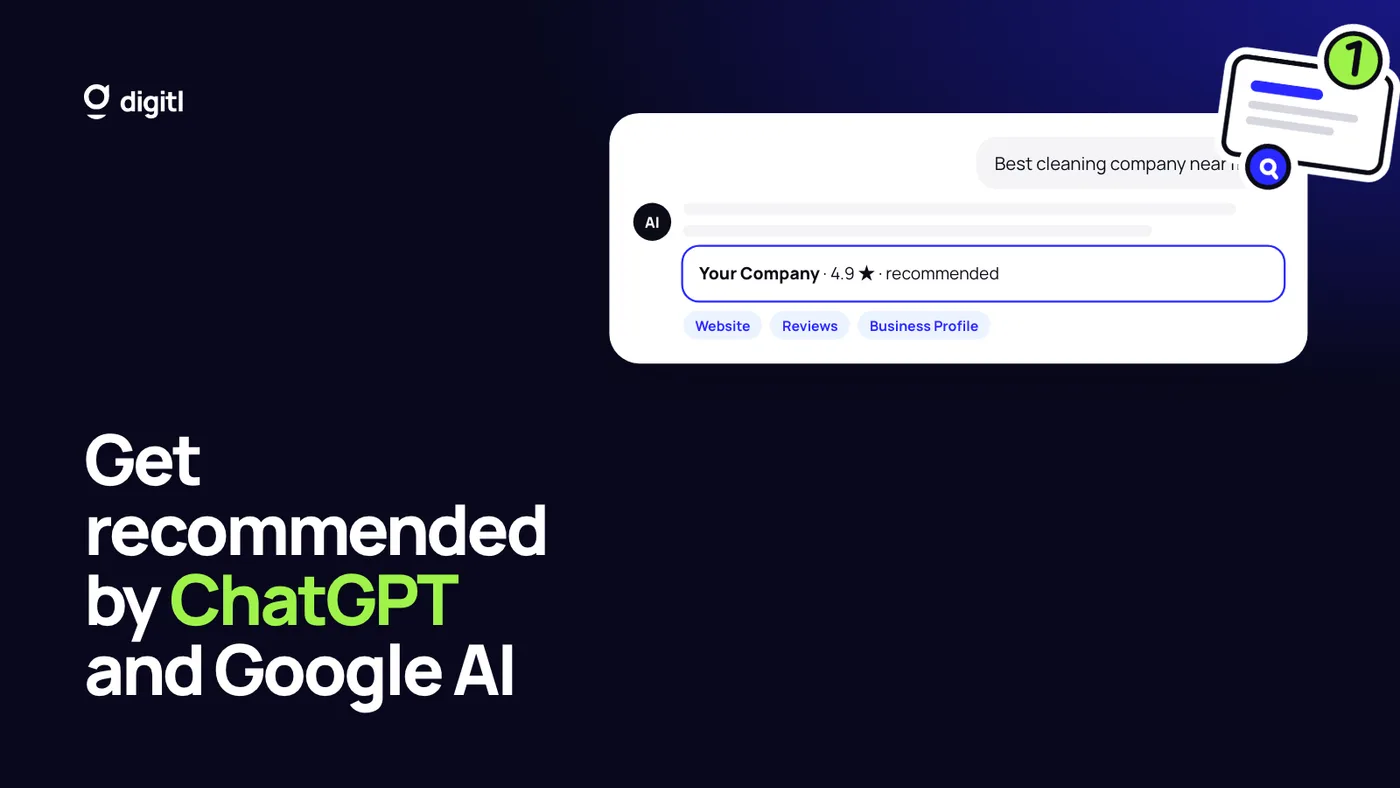
Getting your business to show up in ChatGPT and Google's AI Overviews is mostly ordinary SEO done properly, and it starts with pages the crawlers can read and index. Then comes the part customers see: a clear page for each service you sell, and a complete Google Business Profile that keeps collecting reviews. You don't need special markup, and nobody outside OpenAI or Google can promise you a mention.
How Do ChatGPT and Google's AI Overviews Choose a Business to Mention?
Both search the live web as they answer, and the pages they link to are ones their crawlers could already read and index.
ChatGPT search is a feature of ChatGPT that searches the web while it answers and links to the sources behind the answer. For an owner that matters, since your business can turn up in a ChatGPT answer in two different ways.
The first is memory, when the model names your business from its training data. There's no link, and nothing you fix this month changes it.
The second is a live search, where ChatGPT reads the current version of your pages and links to them. This is the part you can influence. OpenAI keeps a separate crawler for each job, and OpenAI's crawler documentation lists GPTBot for training and OAI-SearchBot for search.
OpenAI's launch post for ChatGPT search, from October 2024, says ChatGPT search uses "third-party search providers, as well as content provided directly by our partners". Bing is the only one of those providers a primary source names.
OpenAI's help page for Enterprise and Edu accounts says ChatGPT may share disassociated search queries with Bing to return web results. Microsoft announced Bing as ChatGPT's default search experience back in May 2023, so we never treat Bing as an afterthought.
Google's AI Overviews work from Google's own index. Google Search Central's page on AI features, dated December 2025, says AI Overviews and AI Mode may use "query fan-out". That's Google's term for issuing several related searches across subtopics to build one response.
For a local service business, the questions that bring in work sound like "who does this near me" or "best cleaner in town". Answers to those lean on local data such as your Business Profile.
Is SEO Dead Because of AI?
No. Google's own documentation says the usual SEO best practices still apply to AI Overviews and AI Mode, which draw on the same indexed pages as Search.
Google's AI features page puts it directly: "There are no additional requirements to appear in AI Overviews or AI Mode, nor other special optimizations necessary." Its 2026 guide to generative AI features, from July 2026, goes further and says optimising for generative AI search "is optimizing for the search experience, and thus still SEO."
The click is what changes. Pew Research Center's browsing data from March 2025 found that Google users who saw an AI summary clicked a traditional result in 8% of visits, against 15% for users who saw no summary. They clicked a link inside the summary itself in 1% of visits.
Google reads the same shift differently. Its AI features page claims that clicks from results pages with AI Overviews are "higher quality", by which it means visitors spend more time on the site.
Both readings can hold at once. For a small business Pew's figure matters more, since fewer people now reach your site and each one who does wants to know roughly what the job costs and whether you cover their area.
So a slow page, or a phone number buried in the footer, wastes a visit you now get less often.
Check your site for free with the Digitl site check. It runs Google's own phone test, so you see how your site loads on a customer's phone.
How Do You Show Up in ChatGPT Search Results?
OpenAI's search crawler, OAI-SearchBot, has to be allowed in your robots.txt file before ChatGPT search can show any of your pages.
OpenAI runs three crawlers, and its crawler documentation treats the robots.txt setting for each one as independent of the others.
| Crawler | What it's for | What blocking it does |
|---|---|---|
| OAI-SearchBot | Finding pages to show in ChatGPT search | Your pages aren't shown in ChatGPT search answers, though they can still appear as navigational links |
| GPTBot | Crawling content that may be used to train OpenAI's models | Your content is marked as off limits for training, with no effect on search |
| ChatGPT-User | Visiting a page when a user's request calls for it | Robots.txt rules may not apply, and this visitor doesn't decide what appears in search |
When did anyone last open your robots.txt file? Type yourdomain.com/robots.txt into a browser and look for a line that names OAI-SearchBot. A blanket "Disallow: /" under "User-agent: *" blocks it too, even though it never mentions OpenAI.
User-agent: GPTBotDisallow: /User-agent: *Allow: /Bot protection is the second place to look. If your host or CDN (the network that serves your site's files) filters automated visitors, OpenAI recommends letting through requests from its published IP ranges. After you change robots.txt, OpenAI says its search systems can take about 24 hours to pick up the change.
Next, check that the indexes ChatGPT draws on hold your pages at all. Bing's webmaster team recommends a sitemap plus IndexNow, a protocol that tells search engines when a page changes. Bing says the pair helps new pages get discovered by Bing and by AI experiences like Copilot.
Submitting a sitemap to Bing Webmaster Tools takes a few minutes, so we'd do it the same day you set up Google Search Console.
Visits from ChatGPT are easy to spot once they start. OpenAI's publisher FAQ says ChatGPT adds utm_source=chatgpt.com to the links it sends, so those visits show up as their own source in Google Analytics.
Since 10 November 2026 there's also a direct route. OpenAI's announcement of Businesses in ChatGPT describes a beta Business Hub, where a business can see its mentions and website clicks inside ChatGPT.
Claim the listing if it's open to you, and copy its name, phone number and services exactly from your site. Don't expect the claim to do the work alone, though, as OpenAI's setup guide says "claiming does not guarantee higher placement or sales."
Before we write any content for a client, we check robots.txt and the CDN's bot settings as part of technical SEO. There's no point planning service pages that OAI-SearchBot can't reach.
How Do You Rank in Google AI Overviews?
Google says a page qualifies for AI Overviews when it's indexed and eligible for a snippet in Search, so there's no separate ranking to chase.
Google's AI features page sets the bar in one sentence: "To be eligible to be shown as a supporting link in AI Overviews or AI Mode, a page must be indexed and eligible to be shown in Google Search with a snippet." It adds that there are no additional technical requirements.
For AI features, Google lists the same basics it asks for in ordinary Search:
- crawling allowed in robots.txt, and by any CDN or hosting setup
- internal links that help Google find the page
- the important content available as text
- structured data that matches the visible text on the page
- an up-to-date Business Profile and Merchant Center account
Snippet controls are the less obvious risk. These are the tags that tell Google how much of a page it may show, and Google says nosnippet, data-nosnippet, max-snippet and noindex all limit what it shows from a page, AI features included.
Say a theme or an old plugin left a nosnippet tag on your service pages. That tag can keep a good page out of AI Overviews. Checking the page source of your main service pages takes a minute, so we'd do it before any new content goes up.
Measuring this needs no paid tool. Google says AI Overviews and AI Mode traffic is reported in Search Console's Performance report under the "Web" search type. Its 2026 guide adds a Generative AI performance report for the same job.
For a service business, AI Overviews matter most on the questions customers ask before they call, such as "how much does an end of tenancy clean cost" or "do I need a permit for a boiler swap". Google can cite a page that answers one of those directly as a supporting link.
Does ChatGPT Use Google Reviews for Local Recommendations?
OpenAI doesn't publish whether ChatGPT reads Google reviews, though Google says more reviews and positive ratings can help its own local ranking.
Google Business Profile Help says local results rest mainly on relevance, distance and prominence. Prominence draws on how many websites link to your business and how many reviews you have.
The same page is blunt about shortcuts: "There's no way to request or pay for a better local ranking on Google." Google's 2026 guide adds that Business Profiles can help your services appear in AI responses, as well as in other Search results.
For ChatGPT, we'd take the course that pays off in Google anyway. Keep the profile complete, and keep real reviews coming in at a steady pace.
Ask every customer the same way, at the same point in the job (say, the day the invoice goes out). Google's Maps content policy bans asking only happy customers for reviews. It bans incentives too, so the request goes to everyone and comes with nothing attached.
For a service-area business, we fill in these fields first:
- the primary category, plus any secondary categories that match real services
- each service, written the way customers name it
- the service area, as the towns or postcodes you really cover
- opening hours, including holiday hours
- the phone number and website address
- recent photos of real jobs
Does your profile list the same services and phone number as your site? Your business name, phone number and service area should read identically wherever they appear, which means your site, the profile and every directory listing.
A customer who meets three versions of your phone number hesitates, and any system pulling details from several places runs into the same mismatch.
Do Schema, llms.txt or FAQ Markup Get You Cited?
None of the three earns a citation on its own, and Google says its AI features need no special schema or AI files.
Google's AI features page is specific: "You don't need to create new machine readable files, AI text files, or markup to appear in these features." Its 2026 guide covers llms.txt and similar files too. Google Search ignores them, so they "will neither harm nor help" a site's visibility in Google Search, and we wouldn't spend client money writing one.
Structured data still has a job: it describes what the page already says in a form machines can read. Google asks that it match the visible text.
FAQ markup no longer earns anything you can see. In August 2023, Google limited FAQ rich results to "well-known, authoritative government and health websites". Later, Google's documentation updates log recorded that the FAQ rich result stopped appearing in Search from 7 May 2026.
We still write an FAQ section for the reader who scrolls down to it, even though the markup behind it no longer shows anything in Google.
Google's 2026 guide adds two more warnings. A separate page for every variation of a search, built mainly to manipulate rankings or AI responses, breaks its scaled content abuse policy. Chasing inauthentic mentions across the web also "isn't as helpful as it might seem."
Be wary, then, of anyone who guarantees you a mention in ChatGPT or a place in AI Overviews. Google says no third-party tool has access to its internal ranking or AI systems. Bing's webmaster team says no tool can guarantee how content appears in AI results either.
All of this is part of our SEO work. We build a page for each service and handle the technical SEO behind it (crawler access, indexing and speed). Local SEO with your Google Business Profile comes next, and optimisation for AI search sits on the same foundation.
Every month you get a report on positions, visits and enquiries from search, so you can see what the work produces. We don't promise a ranking position or a fixed number of enquiries, since nobody outside Google or OpenAI controls the answer.
See what's included in our SEO service for small businesses, from the crawler checks to the monthly report.
What Should a Small Service Business Do First?
Start with crawler access and indexing, the two checks that can shut you out entirely, then move on to the pages and profile customers read.
Most of the work sits in the service pages, which is also where Google's warning on scaled content applies. One page per real service and real area is fine. Google calls it abuse when you publish one page per phrasing of the same question.
When we rebuilt the site for Pando Cleaning Solutions, a cleaning company in Jacksonville, Florida, it became forty-four pages. There's one for every service, every city and every question a customer types before booking. Each page carries its own answer, so a search system has something specific to link to.
Frequently Asked Questions
1. Can I Pay to Get My Business Recommended by ChatGPT?
No. OpenAI's help page on ads says ads run on separate systems from the chat model, and that advertisers "have no ability to shape, rank, or alter ChatGPT's responses." Getting your business recommended by ChatGPT comes down to unpaid work: pages its crawler can read, a place in the indexes it searches, and a claimed Business Hub listing where one is available.
2. Should I Block GPTBot?
Only if you want your content kept out of model training, since blocking GPTBot has no effect on search. OpenAI says the GPTBot and OAI-SearchBot settings are independent, so you can disallow GPTBot and still allow OAI-SearchBot. If you want to appear in ChatGPT search, protect the OAI-SearchBot setting and treat GPTBot as a separate decision about your content.
3. How Long Does It Take to Show Up in ChatGPT or AI Overviews?
There's no fixed timeline, since a new page has to be crawled and indexed first. OpenAI says a robots.txt change takes about 24 hours to reach its search systems. Google says a page needs to be indexed and eligible for a snippet, and it never guarantees indexing itself. A sitemap in Search Console and Bing Webmaster Tools shortens the wait for discovery, and IndexNow helps further with Bing.
4. Do I Need a Separate AI SEO or GEO Service?
Usually not. GEO, short for generative engine optimisation, is a name for making content easy for AI answers to use. Google's 2026 guide treats AEO and GEO as names for the same work, and it says optimising for generative AI search is still SEO. Any SEO service worth paying for should already cover crawler access and indexing, plus your service pages and Business Profile.
5. How Do I Know if ChatGPT Is Sending Me Customers?
Look for utm_source=chatgpt.com in your analytics, since ChatGPT adds it to the links it sends. For Google, check the Web search type and the Generative AI performance report in Search Console. Then ask every new enquiry where they found you, because a customer who read an answer and then phoned you leaves no referral trail in either tool.
What to Do Next
If robots.txt, bot protection or a stray noindex tag is shutting you out, fix that this week. Nothing else counts until OAI-SearchBot and Googlebot can reach your pages.
Once your pages are crawled and indexed, the work moves to what customers read: clear service pages, a complete Business Profile and a steady flow of real reviews. That's ordinary SEO, done for readers who now often meet your business in an AI answer before they see your site.
Book a call through our contact form, and we'll look at what's blocking your site from AI answers, starting with robots.txt and indexing.
Sources
- OpenAI, Overview of OpenAI crawlers, undated, https://developers.openai.com/api/docs/bots
- OpenAI, Introducing ChatGPT search, 31 October 2024, https://openai.com/index/introducing-chatgpt-search/
- OpenAI Help Center, ChatGPT search for Enterprise and Edu, undated, https://help.openai.com/en/articles/10093903-chatgpt-search-for-enterprise-and-edu
- Microsoft, The Official Microsoft Blog, 23 May 2023, https://blogs.microsoft.com/blog/2023/05/23/microsoft-build-brings-ai-tools-to-the-forefront-for-developers/
- Google Search Central, AI features and your website, 10 December 2025, https://developers.google.com/search/docs/appearance/ai-features
- Google Search Central, Optimizing your website for generative AI features on Google Search, 10 July 2026, https://developers.google.com/search/docs/fundamentals/ai-optimization-guide
- Pew Research Center, Google users are less likely to click on links when an AI summary appears in the results, 22 July 2025, https://www.pewresearch.org/short-reads/2025/07/22/google-users-are-less-likely-to-click-on-links-when-an-ai-summary-appears-in-the-results/
- Microsoft Bing, Bing Webmaster Blog, undated, https://blogs.bing.com/webmaster/2025/7/Keeping-Content-Discoverable-with-Sitemaps-in-AI-Powered-Search/
- OpenAI Help Center, Publishers and Developers FAQ, undated, https://help.openai.com/en/articles/12627856
- OpenAI, Introducing Businesses in ChatGPT, 10 November 2026, https://openai.com/index/introducing-businesses-chatgpt/
- OpenAI Help Center, Setting up your business on ChatGPT, undated, https://help.openai.com/en/articles/20001635-setting-up-your-business-on-chatgpt
- Google Business Profile Help, Tips to improve your local ranking on Google, undated, https://support.google.com/business/answer/7091?hl=en
- Google Maps User Contributed Content Policy, Fake engagement, undated, https://support.google.com/contributionpolicy/answer/7400114?hl=en
- Google Search Central Blog, Changes to HowTo and FAQ rich results, 8 August 2023, https://developers.google.com/search/blog/2023/08/howto-faq-changes
- Google Search Central, Latest Google Search documentation updates, 8 May 2026, https://developers.google.com/search/updates
- OpenAI Help Center, Ads in ChatGPT, undated, https://help.openai.com/en/articles/20001047-ads-in-chatgpt
Written byLuka
Have a question about this topic?
The first call is free.