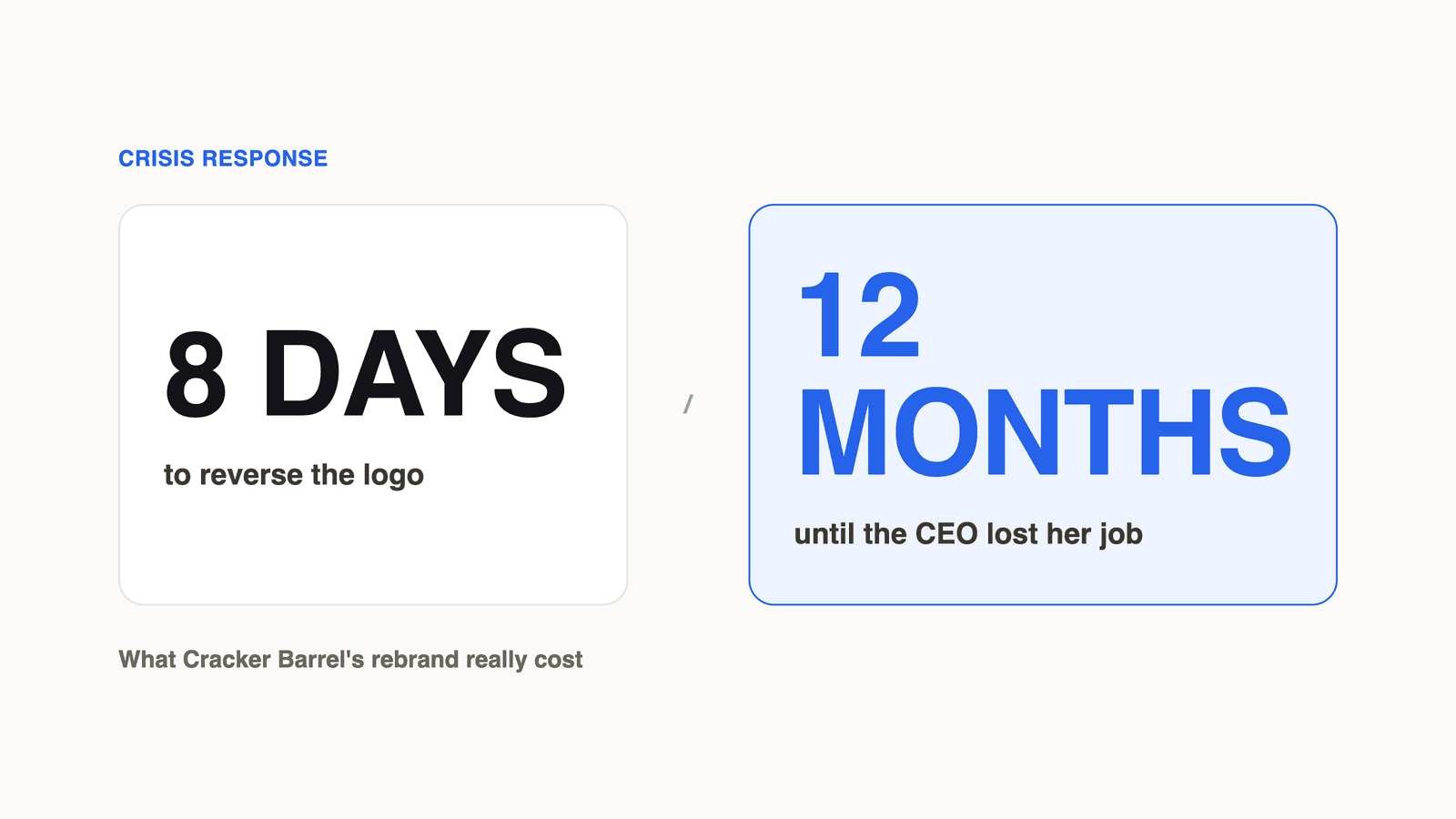
On August 19, 2025, Cracker Barrel launched a new logo that dropped its longtime "Uncle Herschel" mascot for a minimalist wordmark.
The backlash moved fast: an account with roughly 4 million followers amplified it within a day, the stock dropped more than 7% around August 25, and after a Trump Truth Social post on August 26, the company reversed course, bringing the old logo back within eight days (Forbes; Axios).
If you only track the news cycle, that reads like a fast, competent recovery.
It wasn't. Cracker Barrel's own CFO told investors that fiscal Q2 2026, five months after the reversal, brought the steepest traffic decline "since the rebrand debacle," with comparable sales down roughly 7% and traffic down 10% (Restaurant Dive).
It took until around May 2026, nine months after the logo went back, for the sales decline to meaningfully narrow (Yahoo Finance).
Cracker Barrel is a company with a market cap over a billion dollars. It survived nine months of bleeding traffic. Most small businesses would not.
That's the real lesson here, and it has nothing to do with logos specifically. Any visible change, a rebrand, a price increase, new packaging, a policy change, carries a risk that isn't captured by how the initial reaction looks.
The initial reaction is loud and fast. The actual cost shows up slowly, in repeat customers who quietly stopped coming back, and it can run for months after everyone has stopped talking about the controversy.
Two things would have changed Cracker Barrel's outcome, and they're both things a small business can do for free.
First, test the change with a real slice of your actual customers before rolling it out everywhere, not just your team's opinion or a focus group. One location, one email segment, one region, watched for two to four weeks, tells you far more about real behavior than any internal debate does.
Second, write your response plan before you ship the change, not after backlash starts. Decide, in advance, what you'll do in the first 24 hours if the reaction is bad, and who's authorized to make that call without a board meeting.
Neither of those costs money. Both would have given Cracker Barrel real data before a national controversy did it for them.
If you've got a brand, pricing, or packaging change coming up this quarter, that's the whole playbook: test on a slice first, and know your 24-hour plan before you need it.